


infographics
ABOUT TRUST
6 Essential Facts About Trust & Professional Relationships

This infographic presents six essential facts about trust and professional relationships, based on research used by Trusted Advisor Associates.
-
Trust can be built quickly. Trust depends on the type of trust involved. People naturally send and interpret cues that allow trust to form faster than commonly assumed. The belief that trust always takes a long time to build is not always accurate.
-
Intimacy is the most influential factor in trust. Intimacy refers to how safe and secure people feel when sharing with someone. Research shows intimacy is the strongest contributor to trust within professional relationships.
-
Balance across trust traits is critical. Individuals who demonstrate balanced strength across all trust factors are perceived as more trustworthy than those who are strong in one area but weak in others. Improving weaknesses is more effective than relying solely on strengths.
-
Trust improves with age. Measured trustworthiness generally increases as people gain experience over time. Self-assessed trust scores tend to rise with age.
-
Trustworthiness is not gender-neutral. Research indicates that women, on average, score higher on trustworthiness than men, largely due to higher scores in the intimacy component of trust.
-
Expertise does not equal trust. Knowledge and credentials alone do not automatically build trust. Developing soft skills such as intimacy and reducing self-orientation is more effective for improving trust and professional outcomes.
The infographic also references the Trust Equation, which defines trust as Credibility plus Reliability plus Intimacy, divided by Self-Orientation.
How Trustworthy Are You?
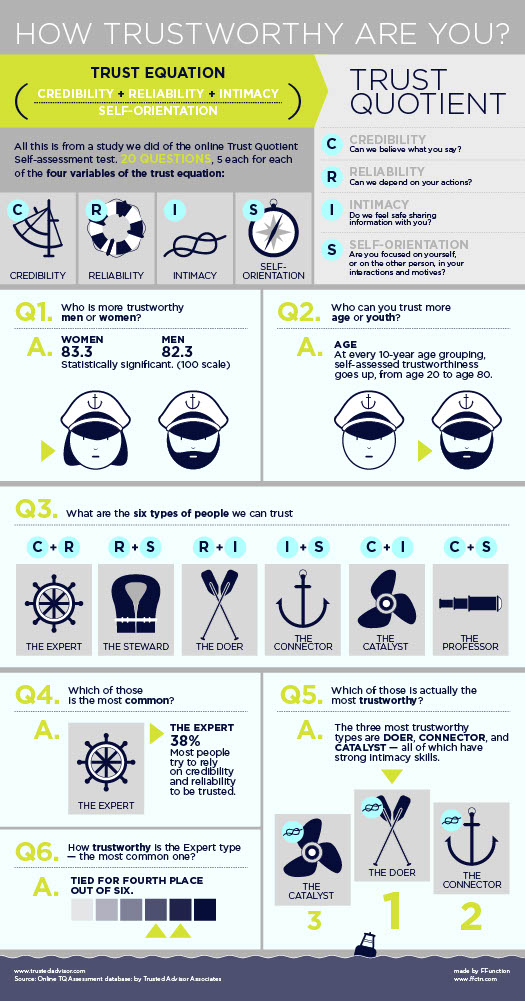
This infographic is titled “How Trustworthy Are You?” and summarizes research findings from the Trust Quotient self-assessment, based on the Trust Equation.
The Trust Equation defines trust as the combination of Credibility, Reliability, and Intimacy, divided by Self-Orientation. The Trust Quotient assessment consists of 20 questions, with five questions for each of the four trust factors.
The four trust factors are defined as follows:
-
Credibility: Can others believe what you say?
-
Reliability: Can others depend on your actions?
-
Intimacy: Do people feel safe sharing information with you?
-
Self-Orientation: Are you focused on yourself or on others in your interactions and motives?
Question 1: Who is more trustworthy, men or women?
Research results show that women score 83.3 and men score 82.3 on trustworthiness, a statistically significant difference on a 100-point scale.
Question 2: Who can you trust more, age or youth?
Trustworthiness increases with age. At each ten-year age grouping, self-assessed trustworthiness scores rise, from age 20 through age 80.
Question 3: What are the six types of people we can trust?
The six trust types identified are:
-
The Expert (Credibility plus Reliability)
-
The Steward (Reliability plus Self-Orientation)
-
The Doer (Reliability plus Intimacy)
-
The Connector (Intimacy plus Self-Orientation)
-
The Catalyst (Credibility plus Intimacy)
-
The Professor (Credibility plus Self-Orientation)
Question 4: Which trust type is the most common?
The most common trust type is The Expert, representing 38 percent of respondents. Most people try to rely on credibility and reliability to be trusted.
Question 5: Which trust types are the most trustworthy?
The three most trustworthy types are The Doer, The Connector, and The Catalyst, all of which have strong intimacy skills.
Question 6: How trustworthy is the Expert type compared to others?
The Expert type ranks tied for fourth place out of six in overall trustworthiness.
The infographic cites data from the Trusted Advisor Associates Trust Quotient assessment database.